Grizzly Bears and Kokanee  

Within the research forest boundary there are two streams in which kokanee salmon come to spawn in the fall. As the kokanee die in these streams, they attract grizzly bears, and allow us to monitor populations of these bears in the area by collecting DNA.

Collaborators

  • Seal with a mountain, pine tree, and wolf, surrounded by the text 'John Prince Research Forest, Tłazten NAL, BCE, UNBC'.

    Shelley Marshall

    Government of British Columbia

  • A young man smiling outdoors in front of a Christmas tree, wearing a beige cap and green jacket.

    Dexter Hodder

    JPRF

  • Seal of John Prince Research Forest featuring a mountain, tree, and wolf with surrounding text.

    Kara Macaulay

    Government of British Columbia
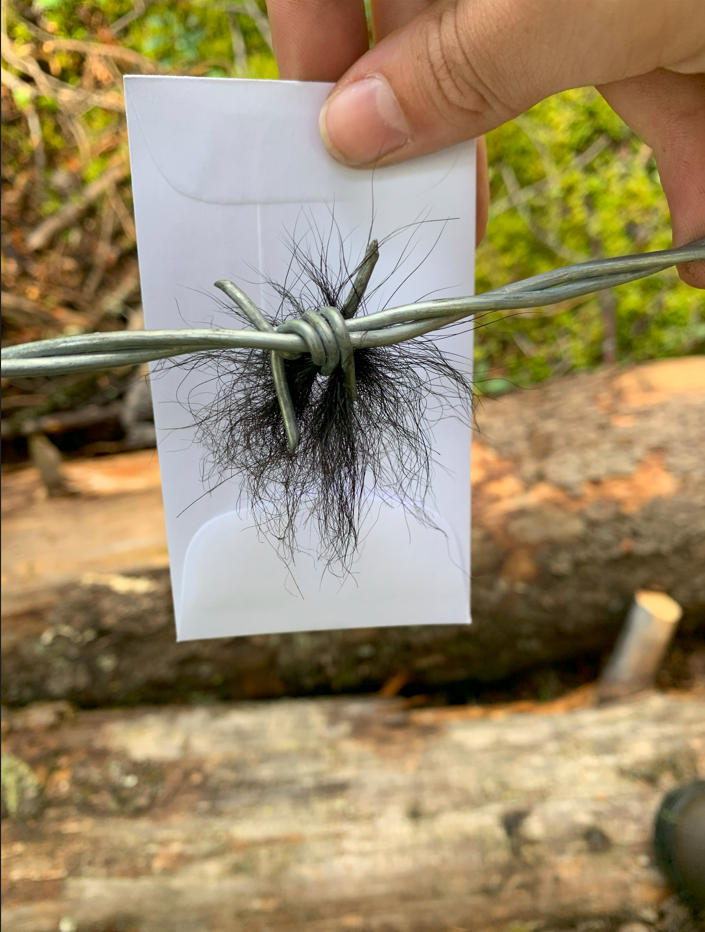
A clump of hair caught in a coil of barbed wire, held up against a background of trees and logs.

How to collect bear hair?

We collect bear hair with barbed wire. The wire is placed at approximately knee height, in a small circle. In the center of the circle is a smelly attractant that draws bears in, and as they cross the barbed wire, small samples of hair get caught in the barbs. These hairs are collected by our staff and then sent to a lab for processing.

Funding provided by

  • Logo for Habitat Conservation Trust Foundation with a circular design featuring a blue and green abstract landscape and the organization's name underneath.

  • Emblem of the John Prince Research Forest featuring a mountain, a tree, a bear, and a bird, encircled by text and a decorative border.

  • Logo of British Columbia featuring a stylized mountain range and a sun with radiating rays, with the text 'British Columbia' below.